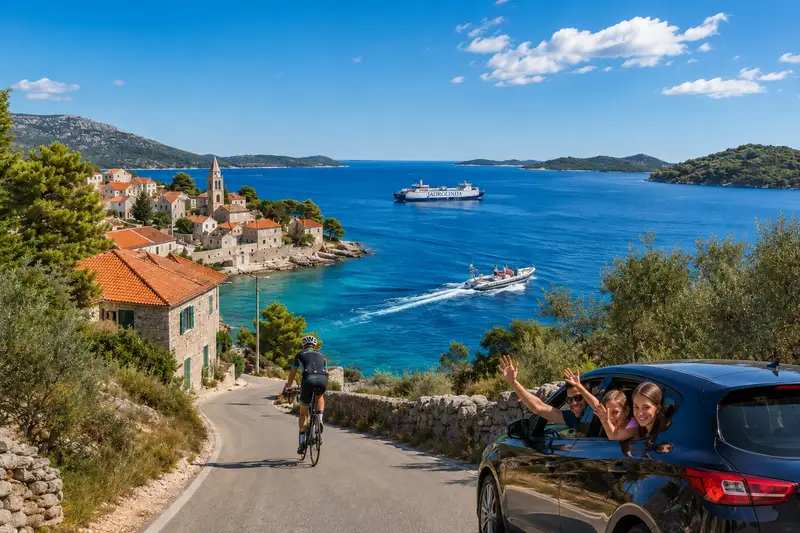
Best Day Trips from Stomorska: Split, Islands & Hidden Bays
Split, islands and hidden bays – with practical local tips

Author: Damir VidanLocal author and member of the Casa Vidan family · Published: · Last updated:
Most guests who visit Stomorska quickly discover that they do not need an ambitious holiday schedule.
The sea is already in front of the house, the village is small enough to explore on foot, and several excellent swimming spots can be reached within minutes from Casa Vidan.
We have already written a detailed guide to the best beaches in Stomorska, including the exact walking distances from our apartments. For guests who want to explore the rest of the island, we have also prepared a guide to the best beaches on Šolta.
Realistically, this is how you will probably spend most of your holiday: breakfast overlooking the bay, a walk to the beach, several hours in the sea, lunch in Stomorska and a slow evening by the waterfront.
However, after a few relaxed days, you may want to see more.
Stomorska is an excellent base for day trips. You can explore the western side of Šolta by car or e-bike, take the ferry to Split, visit another island by speedboat or spend an entire day swimming in coves that cannot easily be reached from land.
How to Organise a Day Trip from Stomorska
There are three main ways to explore the area.
The easiest option is to stay on Šolta and travel by car, scooter or e-bike. Maslinica, Nečujam, Grohote and the island’s inland villages can all be visited without using a boat.
For Split and some of the larger islands, you can travel from Rogač. The car ferry from Rogač to Split takes approximately 60 minutes, and a purchased ticket reserves a place on the selected departure. Schedules change during the season, so always check the official timetable before planning a connecting journey. (Jadrolinija)
The third and most enjoyable option is a private boat.
Casa Vidan’s small Yamaha 25 HP dinghy is ideal for beaches and bays close to Stomorska. It is not intended for long open-sea crossings to Hvar, Vis, Korčula or the more distant parts of Brač. For those trips, you need a larger and faster speedboat, preferably with a skipper if you do not have sufficient experience.
We can help Casa Vidan guests contact local boat owners and skippers in Stomorska and choose a boat suitable for the planned route.
Maslinica and Šolta’s West Coast
Maslinica is the easiest full or half-day trip for guests who want to discover another side of Šolta without leaving the island.

It is the only settlement on Šolta’s western coast and has a noticeably different atmosphere from Stomorska. While Stomorska feels like a traditional fishing village built around a long bay, Maslinica is centred around a small harbour, an elegant marina and an archipelago of seven tiny islands.
A Village Built Around a Castle
Maslinica developed around the estate of the Marchi family. In 1703, the brothers received permission from the Venetian Republic to construct a defensive tower, a settlement and a church. The western coast of Šolta was exposed to pirate attacks, so the new settlement was intended to protect and populate this remote part of the island.
The fortified castle was completed around 1708. Today it has been carefully restored and operates as the Martinis Marchi heritage hotel, restaurant and marina.
Even if you are not staying at the hotel, it is worth walking around the harbour and viewing the castle from the waterfront. The combination of the historic building, modern marina and small islands at the entrance to the bay makes Maslinica one of Šolta’s most photogenic places.
Punta Beach and Beach Bar
Punta is the main public beach in Maslinica and one of the easiest places to spend a relaxed afternoon.

The beach is pebbly and particularly convenient for families. Immediately above it is Beach Bar Punta, where parents can sit in the shade with a coffee, beer or cocktail while still having a clear view of the children swimming below.
The bar is also one of the best sunset locations on Šolta. The sun disappears behind the small islands west of Maslinica, creating one of the rare places on the island where the sunset appears directly over the open sea.
Our recommendation is to visit Punta in the late afternoon rather than at midday. The beach becomes more pleasant as the temperature drops, and you can stay until sunset.
Šipova – Šolta’s Sandy Beach
Many first-time visitors are surprised to learn that Šolta also has a sandy beach.
Šipova is located in a largely undeveloped bay near Maslinica. The shallow sandy bottom makes it especially popular with children, who can spend hours building castles, digging holes and playing in the water.
There are no cafés, shops or organised facilities in the bay, and there is almost no natural shade. Bring plenty of water, sun protection and, for very small children, a beach tent or large umbrella.
During July and August, we prefer visiting early in the morning, late in the afternoon or on a slightly cloudy day. The Šolta Tourist Board also identifies this as the island’s only sandy beach.
Martinis Marchi Marina and Restaurant
The modern Martinis Marchi Marina forms part of the historic castle estate. It has more than 50 berths and is directly connected to the hotel, restaurant and waterfront.
The restaurant is the most refined dining option in Maslinica. Its menu focuses on seasonal Dalmatian ingredients, fresh fish, seafood, local olive oil and regional wines.
This is not the place we would choose for a quick plate of grilled fish in beach clothes. It is better suited to a special lunch or dinner in an elegant setting. Reservations are advisable during the main season.
Where to Eat and Drink in Maslinica
Maslinica has several different options depending on the kind of experience you want.

Martinis Marchi Restaurant is the choice for a polished meal, quality wine and a historic setting.
Sampjer offers a beautiful elevated view over the harbour and is a popular choice for seafood and Mediterranean dishes.
Sakajet Food & Wine is a smaller restaurant in the village with a modern interpretation of local food.
For a relaxed drink, choose Beach Bar Punta, Kažela on the waterfront or the café inside Martinis Marchi Marina. Tripadvisor currently lists Konoba Šešula, Sampjer and Martinis Marchi among the more established dining choices in and around Maslinica.
Our family usually opts for afternoon coffee or beer at Beach Bar Punta, a fish feast at Restaurant Šampjer at sunset, or dinner at Martinis Marchi Manor on special occasions.
Our Suggested Maslinica Day
Arrive during the late morning and begin with a slow walk around the old harbour.
Continue past Martinis Marchi Castle and through the marina. Stop for coffee on the waterfront, then choose between Punta Beach and a visit to Šipova.
Return to Maslinica in the late afternoon, walk through the narrow streets above the harbour and have an early dinner or drinks by the sea.
Finish the day at Punta, watching the sun set behind the seven islands.
Our opinion: Maslinica is the best first day trip for guests who want to see more of Šolta without spending half the day travelling.
Split – The Cultural Capital of Dalmatia
Split is the most practical mainland day trip from Stomorska.

We recommend travelling as a foot passenger rather than taking the car. You can drive to Rogač and leave the car there or use the island bus when its timetable matches the ferry.
The Rogač–Split crossing takes around one hour. Once you arrive, the ferry terminal, Riva, market and Diocletian’s Palace are all within walking distance.
A Short History of Split
Split grew from the palace constructed for the Roman emperor Diocletian at the beginning of the fourth century. The building was not simply a palace in the modern sense. It combined an imperial residence, military structure, religious complex and fortified settlement.
Over the centuries, homes, shops, churches and streets developed inside its Roman walls. This is what makes Split unusual: Diocletian’s Palace is not a closed archaeological site but a living part of the city.
The palace substructures are among the best-preserved ancient complexes of their kind, and Split’s historical centre was included on UNESCO’s World Heritage List in 1979.
Our Recommended One-Day Route Through Split
Start with Breakfast or Brunch
First of all – skip the crazy expensive coffee or food on the Jadrolinija ferry and be patient until Split: it will be worth it.
Choose one of the earliest suitable ferries from Rogač (early in the morning) and begin your day on the Riva before the temperature and crowds increase.
For this particular itinerary, our practical choice is Brasserie on 7 or Baza food bar. Brasserie is located directly on the Riva, serves a substantial breakfast and allows you to begin sightseeing immediately afterwards. This way, you can immediately observe the Riva in Split, one of the most famous promenades in Croatia, and feel the morning pulse of the city.
It is more expensive than a simple local bakery, but recent reviews consistently praise the breakfast selection and waterfront location.
We recommend Baza food bar to those who absolutely need a hearty breakfast for a perfect day, as they will definitely find one of the breakfasts to their taste.
For guests who only want excellent coffee and something small, D16 Coffee inside the old town is a strong alternative and continues to receive excellent reviews from coffee lovers.
Walk Along the Riva While It Is Still Cool
The Riva is Split’s main waterfront promenade and the stage for much of the city’s public life.

Walk west towards the large square known as Prokurative. The square is surrounded on three sides by neo-Renaissance buildings and was developed during the time of mayor Antonio Bajamonti in the 19th century.
Its open southern side faces the sea, giving it a slightly Venetian or Italian character that contrasts with the Roman architecture of the palace.
Return along the Riva before the midday heat begins.
Visit the Market and Enter Diocletian’s Palace

When the sun becomes stronger, walk through the outdoor market (called »Pazar«) beside the eastern wall of the palace. Be careful – if you visit the bazaar with children, you can expect to spend quite a bit of time here.
The market is a good place to buy fruit, local products and something cold to drink. There are also toy stands and a bunch of clothes, sunglasses and football items.
From there, enter the historic centre along the eastern (silver) gate and allow yourself to get slightly lost.
The main sights include:
- the Peristyle;
- the Cathedral of Saint Domnius;
- the Temple of Jupiter;
- the Golden, Silver, Iron and Bronze Gates;
- the palace substructures;
- the narrow streets around People’s Square;
- the small courtyards, stone passages and medieval houses built into the Roman structure.
Visit the monument to Gregory of Nin, where legend says that if you touch his big toe and make a wish, it will come true. For this reason, the entire statue is bronze, while the big toe is gold-coloured from the many touches.
The central passage through the substructures connects the Riva with the Peristyle, while the paid sections reveal the scale and original layout of the imperial apartments above.
Stop for Gelato
For gelato, our first choice is Gelateria Emiliana.
It regularly attracts a queue, especially in the main season, but recent 2026 reviews still place it among Split’s most popular gelaterias. The line can look long, although it generally moves steadily.
Art Patisserie is another well-known choice, especially if you also want cakes or less traditional flavours.
Eat Ćevapi at Kantun Paulina
For a simple lunch that does not interrupt your sightseeing, visit Kantun Paulina, the legendary Split mini restaurant with ćevapi.
The small takeaway has been serving ćevapi since 1967 and remains one of Split’s best-known casual food institutions.
Order ćevapi in lepinja with onions and ajvar (a Balkan condiment made from roasted red peppers, eggplant, garlic and oil), find a shaded bench and eat like a local rather than spending two hours in a restaurant.
Several generations of our family can confirm that this is the meal we stop for most often in Split.
Visit Poljud Stadium

After lunch, take a taxi (Uber), local bus or longer walk towards Poljud Stadium. Poljud was designed by Croatian architect Boris Magaš and built for the 1979 Mediterranean Games. Its shell-shaped roof made it an important example of modern sports architecture. Poljud is the home of HNK Hajduk Split. For many people in Dalmatia, Hajduk is not simply a football club but part of the city’s identity.
Official stadium tours are available, although operating times can vary. The official Hajduk shops sell shirts, scarves, flags and many other club-related products. Check the tour availability before arranging the day around it. Even guests who are not football supporters often find the stadium and the culture surrounding Hajduk interesting. Even in the city of Split itself, you will see a lot of graffiti, flags, and people wearing T-shirts with the recognisable Hajduk logo.
A Few Additional Options
When you return towards the centre, choose one additional stop rather than attempting to see everything. You can walk up the first part of Marjan Hill for a view over the old city, visit the fish market, swim at Bačvice or simply spend another hour exploring the streets inside the palace. Split is far more enjoyable when you leave some time for sitting, watching people and wandering without a strict route.
Dinner Before Returning to Šolta
For a late lunch or early dinner inside the old town, our practical recommendation is the small konoba PustiMeProć.
You’ll have a hard time going wrong with food in this part of Split, and the same applies here, but this tavern has another special feature, as “Pusti me proć” means “Let me pass” – the tavern is located on the street of the same name, which is considered the narrowest in Split and got its name because two passers-by cannot meet in it.
For a more wine-focused dinner, Zinfandel Food & Wine Bistro is another excellent option inside the historic centre, with a large selection of Croatian wines and consistently strong recent feedback.
Always confirm the final Rogač ferry before sitting down for dinner. Seasonal and temporary timetable changes do happen. Don’t miss the last ferry, as this would mean you have to pay a lot for accommodation in Split or a lot for private transportation to Šolta.
Our opinion: Split deserves one full day. Do not try to combine it with Omiš unless you are mainly interested in a quick overview rather than a relaxed visit.
Brač, Hvar and the Nearby Islands
It is possible to visit other islands using public ferries, but the logistics differ significantly.
The least expensive option is to take an early ferry from Rogač to Split and connect to another ferry to one of the islands.
This can work well for Brač and, depending on that day’s timetable, Hvar. It becomes much less practical for Vis and Korčula because the onward journeys are substantially longer. Vis alone is approximately 140 minutes from Split by car ferry.
Drvenik Veli is connected by a public route from Trogir rather than directly from Split, making it inconvenient from Stomorska without a private boat.
A larger rented speedboat is faster, more flexible and far more enjoyable, although naturally more expensive. A skipper is strongly recommended for longer routes unless you have relevant experience, the correct licence and a good understanding of local weather.
Drvenik Veli and the Krknjaši Blue Lagoon
Drvenik Veli is one of the easiest nearby islands to visit by private speedboat.

Its best-known attraction is the Krknjaši lagoon, often marketed as the Blue Lagoon. The shallow water above the pale seabed produces intense shades of turquoise and makes the area excellent for swimming and snorkelling.
The disadvantage is its popularity. During the middle of the day in July and August, multiple organised excursions from Split and Trogir can arrive at the same time.
For a calmer experience, arrive early in the morning or later in the afternoon. Independent guides and recent visitor feedback consistently recommend avoiding the main midday excursion window.
A good private-boat itinerary combines Krknjaši with a short visit to Drvenik Veli village and another swimming stop away from the main lagoon.
Our opinion: this is one of the best options for families and guests who want beautiful water without spending an entire day crossing the open sea.
Brač – Milna and Bol
Brač lies directly across the Splitska vrata channel from eastern Šolta.

By private boat, the natural first stop is Milna, a protected harbour village on the western coast of Brač. It is ideal for a morning coffee, a short waterfront walk and refuelling before continuing along the coast.
From Milna, a faster boat can continue towards Bol and Zlatni Rat.
Zlatni Rat is Brač’s (or even Croatia’s) most famous beach, but it becomes extremely busy in the middle of summer. Arrive early in the morning or later in the afternoon. The beaches around the Dominican monastery, including Martinica and Kotlina, usually offer a calmer alternative.
If travelling by public transport, take the Rogač ferry to Split, connect to the Split–Supetar ferry and continue to Bol by bus, taxi or rented vehicle. This is possible, but a large part of the day will be spent travelling. The Split–Supetar route operates frequently, but connections should be checked carefully.
Our opinion: by boat, combine Milna and Bol. By public ferry, choose one part of Brač and do not attempt to see the entire island.
Hvar and Stari Grad
Hvar is probably the most notorious Croatian island and it offers two very different day-trip experiences.

Hvar Town is elegant, lively and visually impressive. Its harbour, stone square, cathedral, hillside fortress and nearby Pakleni Islands make it one of Croatia’s best-known destinations.
It is also one of the busiest.
Arrive early, explore the old centre before the excursion boats arrive and either eat lunch before noon or wait until the busiest period has passed.
Stari Grad offers a slower and more historic atmosphere. Its narrow streets, stone courtyards and sheltered harbour feel calmer than Hvar Town, particularly outside the peak arrival hours.
Public fast-boat connections operate from Split to Hvar, while car ferries connect Split with Stari Grad. Connecting from Šolta is possible on selected schedules, but you must compare both outbound and return departures before buying tickets.
With a private speedboat, you can visit one town and add a swimming stop around the Pakleni Islands. Attempting both Hvar Town and Stari Grad in one day is possible only with efficient transport and will feel rushed.
Our opinion: choose Hvar Town for architecture, energy and iconic views. Choose Stari Grad for a quieter and more authentic day.
Vis – Blue Cave, Green Cave and Stiniva
Vis is one of the most spectacular islands in Dalmatia, but it is also a serious full-day trip from Stomorska.

The main attractions are spread across Vis, Biševo and the small island of Ravnik, so this trip requires a fast boat, an early departure and stable weather.
The Blue Cave on Biševo is illuminated when sunlight enters through an underwater opening and reflects from the pale seabed.
The strongest blue effect is generally seen in the late morning, often around 11:00–13:00, although the precise timing changes with the season, weather and sea conditions. Arriving very early can reduce the waiting time, but the colour may be less intense.
The cave has a very low entrance and may close when the sea is rough. This means no operator can guarantee entry before the conditions are known that morning.
The Green Cave is located on Ravnik. Sunlight enters through an opening in the ceiling and produces the strongest green effect around midday.
Stiniva is a dramatic cove enclosed by high cliffs and a narrow entrance from the sea. Visit early, before the larger excursion groups arrive. Later in the day, the small beach and entrance can become congested.
A well-planned Vis tour may also include Komiža, Budikovac or a short stop in Hvar Town on the return route. Do not attempt to include every advertised location simply to create a longer list.
Our opinion: Vis offers the most impressive boat day, but it is also the longest, most expensive and most dependent on weather.
Korčula and Vela Luka
Korčula is beautiful, but it should not be presented as an easy day trip from Stomorska.

Reaching it first requires a crossing to Split followed by a long onward journey, or a substantial private-speedboat route. In practice, it is more suitable for an exceptionally long private excursion or an overnight stay.
The most relevant destination from Stomorska is Vela Luka, located in a deep bay on the western side of Korčula.
Vela Luka is closely connected with Oliver Dragojević, one of Dalmatia’s most beloved singers. A permanent memorial collection dedicated to his life and work is located in the local cultural centre.
Every year, Vela Luka also organises the Trag u beskraju programme in his memory, with concerts and events that attract large numbers of visitors. During this period, transport and accommodation should be arranged well in advance.
Other local highlights include the archaeological cave Vela Spila, the long waterfront and boat trips to the nearby island of Proizd.
Korčula Town lies on the opposite side of the island. Trying to combine Vela Luka and Korčula Town on a day trip from Stomorska would involve too much travel.
Our opinion: visit Vela Luka if Oliver’s music has a personal meaning for you. Otherwise, save Korčula for a separate overnight journey.
Exploring Šolta by Boat
A boat changes the way you experience Šolta.
From the road, the island may appear relatively small and simple. From the sea, it reveals a long chain of coves, cliffs, tiny beaches and sheltered anchorages that are invisible from the main villages.
Our small Casa Vidan dinghy is suitable for short trips close to Stomorska, such as Gornja Krušica and nearby swimming spots.
It is not the right boat for circling the entire island. For a full coastal tour, rent a larger speedboat with sufficient range, comfort and safety equipment. The direction of the route should be chosen according to the wind and sea conditions on that specific day.
We have already described most of the better-known bays and beaches in the article “The Best Beaches on Šolta”, so now we will focus on the lesser-known ones, which can be reached more easily by boat than by car.
Donja Krušica
Donja Krušica is a small former fishing settlement on the northern coast of Šolta. Stone houses line the sheltered bay, creating a traditional atmosphere that feels very different from the island’s larger tourist settlements. It can also be reached from Donje Selo by a narrow road, but arrival by sea is more memorable. Use it as a quiet morning swimming stop rather than expecting extensive facilities.
The Seven Islands in front of Maslinica
Approaching Maslinica from the sea offers the best view of the castle, marina and seven small islands outside the harbour. Stop for coffee, supplies or a short walk, but save the main lunch stop for nearby Šešula.
Šešula
Šešula is a deep bay immediately south of Maslinica and one of the island’s best-known nautical locations.

Its shape offers natural shelter, and two restaurants – Šišmiš and Konoba Šešula – serve guests arriving by boat. Both are located directly in the bay, and mooring assistance is commonly available for restaurant guests. This is the most practical lunch stop during a full circuit of Šolta. Reserve a table and mooring in advance during July and August. There is also a fish farm in Šešula, so you can stop and buy some fish if the owner is there.
Jorja
Jorja is a smaller and more intimate bay on the southern side of the island. It is surrounded by steep rocky slopes and is especially attractive to guests who want to combine swimming with lunch in a secluded location. A small family-run restaurant Lero operates in the bay during the season. Compared with Šešula, Jorja feels less like a busy nautical destination and more like a hidden stop.
Grabova
Grabova is one of the more remote swimming stops on Šolta’s southern coast. There is little or no tourist infrastructure, so treat it as a place for swimming, snorkelling and enjoying the scenery rather than a serviced beach. Access information is limited, and the bay is most commonly approached by boat.
Livka
Livka lies at the far south-eastern end of Šolta, close to Brač and the Splitska vrata channel.

At the end of the bay is a small pebble beach and intensely clear water. The bay is exposed to winds from the south, so it should only be included when the forecast is suitable.
Because of its location, Livka is a logical final swimming stop before returning to Stomorska.
It is also one of our favourite fishing spots (personal hint).
Suggested Full-Day Route Around Šolta
A possible route, subject entirely to weather, is:
- Early departure from Stomorska
- Morning swim in Donja Krušica
- Coffee and short walk in Maslinica
- Lunch in Konoba Šešula
- Swimming in Jorja, Tatinja or Grabova
- Final stop in Stračinska or Livka
- Return to Stomorska before the evening
Do not treat this list as a requirement to visit every bay.
The best boat days usually include fewer stops and more time swimming. A local skipper may also reverse the direction of the route depending on the wind.
Our opinion: for most guests, a larger boat with a skipper offers the best balance of safety, relaxation and local knowledge.
Omiš and the Mouth of the Cetina River
Omiš offers a completely different landscape from the islands.

The town stands where the Cetina River passes between steep mountains and meets the Adriatic Sea. Within a very small area, you can experience a river canyon, sandy coastline, medieval old town and dramatic mountain scenery.
Omiš is around 25 kilometres south of Split and can be combined with a mainland visit using a bus, taxi or organised tour. It can also be approached from the sea by private speedboat.
The Town of Pirates
The area around the Cetina mouth has been inhabited for more than 2,000 years.
During the 12th and 13th centuries, Omiš became famous for its pirates, led by the Kačić family. Ships travelling along this part of the Adriatic were forced to pay for safe passage or risk being attacked.
The old town still reflects this defensive history, with narrow streets compressed between the river, sea and mountains.
What to See in Omiš
Begin with a walk through the small historic centre. Climb to Mirabela Fortress, which rises immediately above the old town. The climb is relatively short, although the stairs become hot during summer. For a larger panoramic view, visit Fortica Fortress higher on the mountain. This requires more time, suitable footwear and sufficient water, but the view extends over Omiš, the Cetina canyon, Brač, Hvar and Šolta.
At the river, choose between a gentle boat journey into the canyon and a more active experience such as rafting, canyoning or ziplining. The Cetina canyon has been protected as a significant landscape for decades and contains medieval fortifications, traditional villages and restaurants specialising in regional food.
Local Food
Try soparnik, a traditional thin pie filled with Swiss chard and onions. It is one of the best-known dishes of the Poljica region. Other local choices include grilled fish, Dalmatian prosciutto and dishes prepared under the peka (our favourite is octopus under the peka). For a meal inside the canyon, Kaštil Slanica offers traditional Dalmatian food in a historic riverside setting. The restaurant stands on the site of a former medieval salt market.
Can Omiš Be Combined with Split?
It can, but only as a fast overview. Take an early ferry to Split, spend the morning in the historic centre and continue to Omiš after lunch by bus, taxi or organised tour. You will have enough time to see the old town, river mouth and Mirabela, but probably not enough for rafting, Fortica and a relaxed canyon meal. For the full Omiš experience, give it a separate day.
Our opinion: choose Omiš if you want a break from islands and beaches and would enjoy a combination of history, mountains and river scenery.
We Help Casa Vidan Guests Organise Day Trips
The best day trip depends on the weather, the season and the people travelling with you. Families may prefer Maslinica, Brač or a short boat day around Šolta. Couples may enjoy Hvar, a quiet lunch in Jorja or sunset in Maslinica. Adventurous guests may choose Vis, the Blue Cave or the Cetina canyon. Guests staying at Casa Vidan can contact us for help with:
- local boat and speedboat rentals;
- finding a skipper;
- restaurant reservations;
- ferry and bus information;
- selecting a route suitable for the weather;
- organising transfers from Stomorska.
After a long day exploring Split, the islands or hidden bays, you will return to the quiet waterfront of Stomorska – and perhaps appreciate even more why most of your holiday does not need to be complicated.

Stay at Casa Vidan
Three unique apartments, crystal-clear sea and one of Šolta’s most authentic fishing villages.
You can click on the apartment of your choice below to see pictures, description and available dates.
Accommodation in Stomorska
Browse our sea view apartments in the heart of Stomorska.
About the author
Fourth generation of the Vidan family on Šolta · Author of the local guides · Olive grower
Damir Vidan is the fourth generation of the Vidan family connected to the island of Šolta, and his daughter is already the fifth. He is one of the family members who look after Casa Vidan and the author of the local guides, which are based on his own experience of Stomorska and Šolta.
He also runs the local family farm OPG Damir Vidan, where he grows olives and produces organic olive oil. When he is not among the olive trees or at Casa Vidan, he prefers to spend his time outdoors - on the boat, by the sea or on one of the quiet, secluded beaches in the shade of the pines.
More about the author - Damir VidanHow this content is made
The Casa Vidan local guides are based on first-hand experience of Stomorska and the island of Šolta. Information that can change - such as timetables, transport connections or local rules - is checked against official sources and updated when needed.
Last updated: